
How to Properly Clean Eyeglasses: The Complete West Georgia Guide (Without Ruining the Coating)
Quick Answer: The best way to clean eyeglasses is to rinse them under lukewarm water, apply one small drop of plain dish soap (lotion-free), gently rub with clean fingertips, rinse thoroughly, and dry with a clean microfiber cloth. Never use your shirt, paper towels, or household glass cleaner. Do this daily to protect your lens coatings and keep your vision clear.
Picture this.
You're sitting in a meeting, squinting at the whiteboard, convinced your prescription has gotten worse. You pull off your glasses, give them a quick wipe on your shirt, put them back on — and somehow they look worse. Smearier. Blurrier. Like you're watching the world through a foggy car window.
Sound familiar?
Here's the hard truth: most of us have been cleaning our glasses wrong for years. Not just wrong — we've been slowly scratching, smearing, and degrading the very lenses we depend on every single day. If you've ever wondered "why do my glasses still look smudgy after cleaning?" or "how do I remove fingerprints from glasses without scratching the coating?" — you're in the right place.
The good news? Cleaning your eyeglasses the right way takes about 60 seconds. Once you know how, you'll never go back.

Why Do Glasses Get Dirty So Fast?
Before we get to the "how," let's talk about the "what."
Your lenses collect a cocktail of grime every single day:
Skin oils and fingerprints from touching the frames
Dust and debris floating in the air
Makeup, sunscreen, and lotions that transfer from your skin
Breath fog that leaves behind mineral deposits over time
Most modern lenses also have special coatings — anti-reflective, UV protection, blue-light filtering — and these coatings are surprisingly delicate. The wrong cleaning method doesn't just smear the dirt around. It damages those coatings permanently.
That's why your 3-year-old lenses look scratched and hazy even though you've "been careful." You probably weren't using the right method. And if you've been wondering how to clean glasses with anti-reflective coating without damaging it — that's exactly what this guide covers.
The 60-Second Method That Actually Works
What You'll Need
Dish soap (plain, lotion-free, fragrance-free — think original Dawn)
Warm water (not hot)
A clean microfiber cloth
That's it. No special sprays required.
Step 1: Wash Your Hands First
This sounds obvious, but it's the step most people skip. If your hands are oily or dusty, you're just transferring new grime onto the lenses before you even start. A quick 20-second hand wash makes a real difference.
Step 2: Rinse the Lenses Under Warm Water
Hold your glasses under a gentle stream of lukewarm water. This loosens dust and particles before you touch the lenses. Skipping this step is like dry-wiping a dusty countertop — you're just dragging the grit across the surface and creating micro-scratches.
Important: Avoid hot water. It can warp plastic frames and damage lens coatings over time.
Step 3: Add a Tiny Drop of Dish Soap
Put one small drop of plain dish soap on each lens. Use your clean fingertips to gently rub both sides of the lens, the frame, the nose pads, and even the temples (the arms that go over your ears). Those areas collect skin oil and bacteria like you wouldn't believe.
Rub gently in small circles for about 20 seconds per lens.
Avoid: Soaps with moisturizers, antibacterial additives, or strong fragrances. These leave a film that's actually harder to remove than the dirt you started with.
Step 4: Rinse Thoroughly
Rinse until all the soap is gone. Any soap residue left behind will dry into a cloudy film — which is exactly what you were trying to get rid of.
Step 5: Dry with a Clean Microfiber Cloth
Gently shake off excess water, then use a clean, lint-free microfiber cloth to dry the lenses. Use light pressure and soft circular motions.
The key word here is clean. A microfiber cloth that's been sitting in your bag, rubbing against loose change and receipts, is covered in debris. Wash your microfiber cloths regularly (cold water, no fabric softener) and keep them stored in a clean pouch.
What NOT to Do (The Hall of Shame)
Let's be honest about the habits that are wrecking your lenses:
❌ Your shirt or clothing Fabric — even soft cotton — is rough at a microscopic level and almost always has debris in it. Wiping with your shirt is the single most common cause of lens scratches. We know it's tempting. Resist.
❌ Paper towels, tissues, or napkins Paper products are made from wood fibers. Under a microscope, they look like sandpaper. They feel soft to skin but they are not soft to your lens coatings.
❌ Breathing on your lenses The warm mist from your breath does loosen oils, but it also deposits acids from your mouth onto the lens. Combined with a dry wipe, it creates more scratching than it prevents.
❌ Household glass cleaner (like Windex) This is a big one. Products like Windex contain ammonia and other harsh chemicals that strip anti-reflective coatings right off your lenses. Never use them on eyeglasses.
❌ Saliva Just… no.
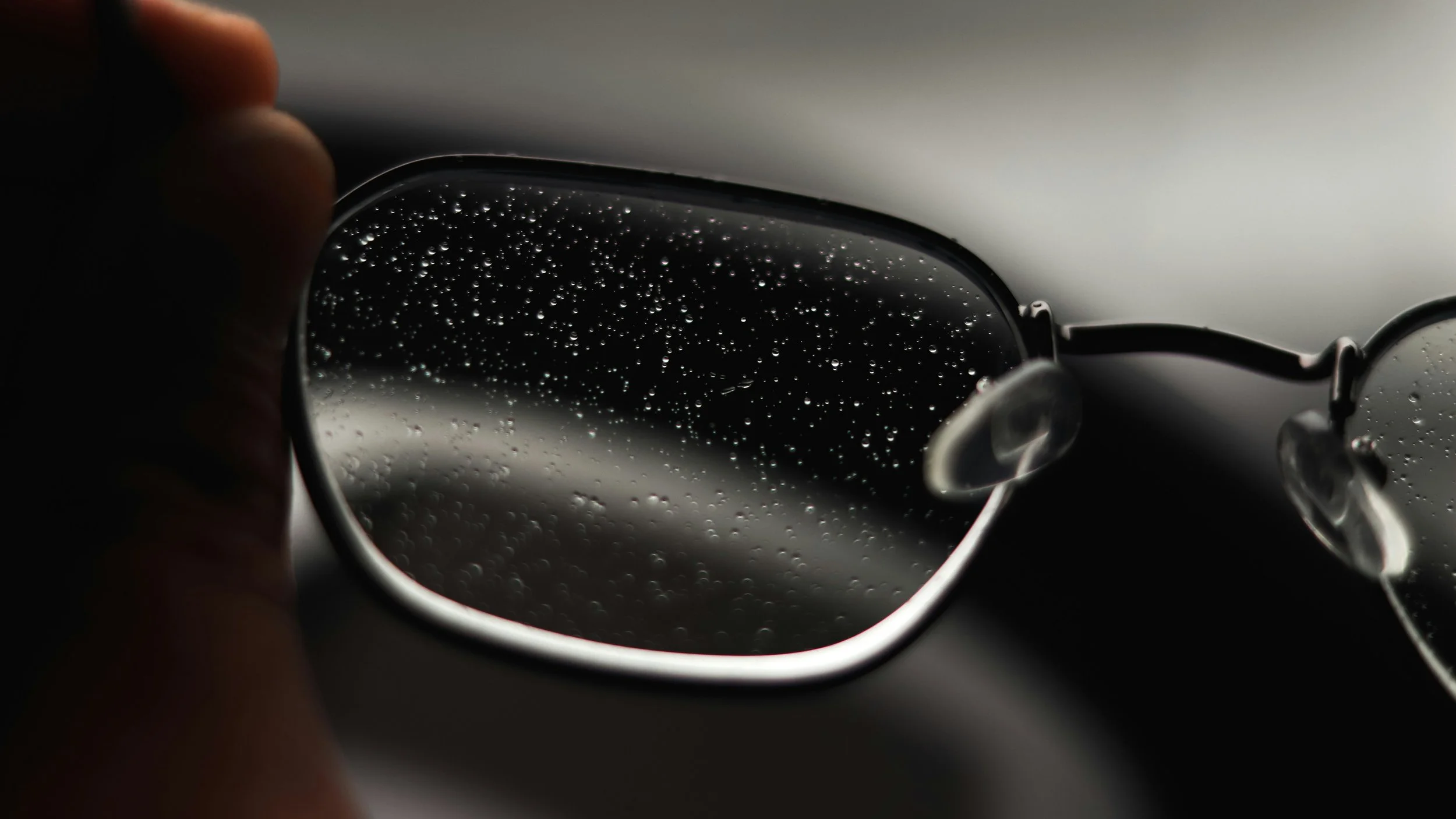
"Wiping your glasses on your shirt isn't cleaning them — it's sanding them. Slowly, invisibly, every single time."
What About Lens Cleaning Sprays?
Lens cleaning sprays from your optician or eyewear store can work well — if they're formulated specifically for coated optic lenses. Always check the label.
They're great for a quick on-the-go refresh paired with a clean microfiber cloth. But for a thorough daily clean, the dish soap and water method is more effective and gentler on coatings.
A word of caution on pre-moistened lens wipes: while they're widely sold and marketed for eyeglasses, they come with a real risk most people don't think about. The wipe itself is a firm, textured material — and if you apply even moderate pressure while wiping, you're essentially dragging that stiff cloth across your lens surface. Any dust or debris trapped under the wipe gets ground right into the coating. Scratches from pre-moistened wipes are surprisingly common, and because they happen gradually, most people never connect the two. If you do use them, the lightest possible touch is essential — but honestly, a clean microfiber cloth and a proper rinse will always be the safer choice.
Want Glasses That Stay Cleaner Longer? Here's What to Ask For
Here's something your optician might not have mentioned: the coating on your lenses matters just as much as the lens itself. Two pairs of glasses with identical prescriptions can behave completely differently — one needs constant wiping, the other sheds fingerprints with a flick of the wrist. The difference almost always comes down to what's on the surface.
Think of a lens coating like a very thin invisible shield. You can't see it, you can't feel it, but it controls everything about how water, oil, dust, and debris interact with your lens every single day. If that shield is cheap or missing, the lens beneath it is fighting a losing battle no matter how carefully you clean.
Here's what the best coatings actually do — in plain terms.
Hydrophobic Coatings (Water-Repelling)
Imagine two car windshields in the rain. One hasn't been treated — water spreads into a flat sheet and stays there. The other has been treated with a water-repelling product — droplets bead up, roll down, and the glass stays clear. A hydrophobic lens coating works exactly the same way.
The coating reduces how strongly water molecules are attracted to the lens surface, so instead of spreading into a smear, water beads up and rolls off. Rain, sweat, and breath fog all shed faster and leave far less residue behind — which means less cleaning and fewer streaks throughout the day. According to Zeiss, top-tier hydrophobic coatings can be cleaned with little more than running water and a gentle shake — barely needing a microfiber cloth at all.
Oleophobic Coatings (Oil-Repelling)
"Oleo" means oil — and this is the coating that makes the biggest difference in daily life. Every time you touch your frames, adjust your glasses, or rub your eye near the lens, skin oil transfers to the surface. On an uncoated lens, that oil bonds and smears. On an oleophobic lens, it sits on top and wipes away cleanly with the lightest touch.
Research into oleophobic coatings shows that fluorocarbon compounds are deposited onto the lens surface to create a layer that actively repels both oil and water — which is why the best coatings combine both properties into a single top layer. The result is a lens that resists fingerprints, cleans in seconds, and holds up to daily handling far better than a basic coated lens.
This is the coating most people wish they'd asked for when they picked up their last pair.
The Best of Both: Multi-Layer Premium Coatings
The top tier of lens protection doesn't stop at hydrophobic and oleophobic. Premium multi-layer coatings from brands like Crizal (Essilor), Zeiss DuraVision Platinum, and Hoya Recharge stack up to nine ultra-thin layers — combining water-repelling, oil-repelling, anti-reflective, UV protection, scratch resistance, and anti-static properties into a single seamless finish.
That anti-static layer is one people rarely ask about — but it's a quiet game-changer. Static electricity is a major reason dust clings to lenses so aggressively, especially in dry environments or during allergy season. An anti-static coating neutralizes that charge at the surface level, so airborne particles are simply less attracted to the lens in the first place. Less attraction means less settling, which means less cleaning.
The American Optometric Association recommends discussing lens coatings with your eye doctor at every prescription update — not just anti-reflective, but the full package of surface treatments that affect how the lens performs day to day.
Here's a quick comparison of what to look for:
Coating Type: Hydrophobic
What It Does: Repels water
Benefit: Rain, sweat, and fog bead off quickly
Coating Type: Oleophobic
What It Does: Repels oils
Benefit: Fingerprints wipe away cleanly
Coating Type: Anti-static
What It Does: Neutralizes charge
Benefit: Dust doesn't cling to the lens
Coating Type: Anti-reflective
What It Does: Reduces glare
Benefit: Clearer vision, less eye fatigue
Coating Type: Scratch-resistant
What It Does: Hardens the surface
Benefit: Protects against everyday micro-abrasions
Premium multi-layer coatings typically cost $50–$150 more than basic lenses — but spread across 2 to 3 years of wear, that's less than $5 a month for dramatically less frustration, fewer cleaning sessions, and lenses that stay clearer far longer.
Pro tip: When shopping for new lenses, ask specifically about oleophobic and anti-static layers by name. A basic "anti-reflective" package doesn't always include them — and the difference in day-to-day cleanliness is significant enough that most people who upgrade never go back.
That said — even the best coatings in the world still need proper care. They reduce how often you clean, not whether you clean. The 60-second method above still applies.
👓 Not Sure Which Coating Is Right for You?
At West Georgia Eye Care, our team takes the time to match you with the right lens coating for your lifestyle — whether you're dealing with dry environments, long screen hours, active outdoor use, or just tired of constantly cleaning your lenses.
During your eye exam, we'll walk you through your coating options in plain language, no jargon, no pressure — just honest advice from people who care about your vision.
How Long Does a Top-Tier Lens Coating Actually Last?
This is one of the most common questions people never think to ask until it's too late — usually when they're staring at a pair of hazy, crazed lenses that are only 18 months old.
The short answer: a premium multi-layer coating is designed to last the life of the lens — roughly 2 to 3 years for most wearers, and longer for those who are meticulous about care. The coating itself doesn't have an expiration date. It doesn't just quietly wear out on its own. It gets destroyed — almost always by specific habits that are completely avoidable.
What Kills a Coating Prematurely
Dry wiping is the single biggest offender. Every time you drag a cloth — or worse, your shirt — across a dry lens, you're grinding microscopic dust and debris directly into the coating. You can't see or feel the damage happening, but it accumulates with every wipe until the surface is dull and scratched beyond recovery.
Heat exposure is the silent killer. Leaving your glasses in a hot car seems harmless, but interior temperatures can reach 150°F or higher on a summer day. At that heat, the multiple coating layers expand and contract at slightly different rates, eventually causing crazing — that eerie spiderweb-crack pattern you sometimes see on older lenses. Once crazing appears, the lens is done. No fix exists.
Harsh chemicals can do immediate, visible damage. A single accidental spray of Windex, hairspray, or perfume near your lenses can start breaking down the coating within minutes. This is why storing your glasses properly — away from your bathroom counter or vanity — matters more than most people think.
The wrong soap causes slow, invisible buildup. Moisturizing or antibacterial hand soaps leave a film that bonds to coating surfaces over time. It doesn't wipe away cleanly, and it gradually clouds the lens from the inside out.
How to Tell If Your Coating Is Failing
Watch for these warning signs:
A persistent hazy or cloudy film that doesn't come off no matter how well you clean
Crazing — fine, web-like cracks visible when you hold the lens up to light
Increased glare even in ordinary lighting conditions
A rainbow sheen visible at certain angles
Once any of these appear, the coating cannot be repaired or restored at home. Replacement is the only solution — which is exactly why prevention is worth so much.
"A lens coating doesn't wear out — it gets destroyed. Almost always by habits that take less than five seconds and feel completely harmless."
How Often Should You Clean Your Glasses?
Every day. Ideally, every morning as part of your routine.
Your glasses sit on your face for 12–16 hours a day. They touch your skin, your hair, random surfaces you set them on, and the inside of your bag or case. A daily clean keeps buildup from becoming a permanent haze, and it extends the life of your coatings significantly.
Think of it like brushing your teeth — a daily minute of care beats a monthly deep-clean of damage. The American Optometric Association recommends daily cleaning as standard practice for all eyeglass wearers, and Consumer Reports echoes the same guidance: consistent gentle cleaning is far less damaging than infrequent scrubbing.
Storing Your Glasses the Right Way
Cleaning is only half the battle. How you store your glasses matters just as much.
Always use a hard-shell case when you're not wearing them. Setting glasses face-down on a table — even a clean one — scratches the lenses.
Keep a microfiber pouch for quick storage on-the-go.
Don't leave glasses in a hot car. Extreme heat warps frames and degrades coatings.
Keep them away from hairspray and perfume. The chemicals in aerosol products coat lenses and are notoriously hard to remove.
A Note on Scratched Lenses
Unfortunately, if your lenses are already scratched, there's no home remedy that fixes them. Toothpaste, baking soda, and car wax are popular suggestions on the internet — and they all make things worse. They're abrasives that create more scratches and remove coatings.
If your lenses are heavily scratched, the only real solution is replacement. But with the proper cleaning routine going forward, you'll keep your next pair in much better shape.
Frequently Asked Questions About Cleaning Eyeglasses
Can I use rubbing alcohol to clean my glasses?
It's best to avoid it. While rubbing alcohol does disinfect, it's too harsh for most modern lens coatings. Repeated use strips anti-reflective and oleophobic coatings over time, leaving lenses hazy and unprotected. Stick to dish soap and water for daily cleaning.
Can I clean my glasses with hand sanitizer?
No — for the same reason as rubbing alcohol. Most hand sanitizers contain 60–70% alcohol, which is aggressive enough to degrade lens coatings with regular use. It might seem fine at first, but the damage builds up invisibly until one day your lenses look permanently cloudy.
How do I clean my glasses without a microfiber cloth?
If you're in a pinch, the safest option is to rinse the lenses thoroughly under lukewarm water and let them air dry. Shaking off the excess water first speeds this up. Avoid using anything fabric-based — shirt, tissue, paper towel — as all of these cause micro-scratches. A clean microfiber cloth is worth keeping in your bag for exactly these moments.
Why do my glasses still look smudgy after cleaning?
A few common culprits: soap residue that wasn't fully rinsed off, a dirty microfiber cloth spreading oils around instead of removing them, or existing coating damage that makes the lens surface uneven. Try a fresh cloth and make sure you rinse until the water sheets off cleanly with no suds.
Is it OK to clean glasses every day?
Not only is it OK — it's recommended. Daily cleaning with the right method is much gentler on coatings than letting oils and grime build up and then scrubbing harder to remove them. Think of it as maintenance vs. repair.
How do I clean glasses with anti-reflective coating without damaging it?
The dish soap and water method is ideal. The key rules: always rinse first to remove loose particles, use only lotion-free and fragrance-free soap, rub gently with fingertips only (no abrasive materials), and dry with a clean microfiber cloth using light pressure. Never use household glass cleaners, acetone, or alcohol-based products on AR-coated lenses.
How do I get rid of the cloudy film on my glasses?
A cloudy film is usually caused by soap residue, hard water mineral deposits, or coating breakdown. Try the full dish soap and water method with an extra-thorough rinse. If the cloudiness persists after a proper clean, it may be coating damage — which unfortunately means the lens needs to be replaced.
The Bottom Line
Cleaning your eyeglasses properly comes down to three things:
Use the right materials — dish soap, warm water, microfiber cloth
Rinse before you wipe — always loosen debris before touching the lens
Do it daily — consistency protects your coatings over time
Your glasses aren't just an accessory — they're a medical device you depend on. They deserve better than a quick shirt wipe and a prayer.
Sixty seconds a day. That's all it takes to keep your vision clear and your lenses lasting years longer than they otherwise would.
Ready to See the Difference a Great Pair of Lenses Makes?
Your glasses should work for you — not against you. If you're overdue for an exam, noticing changes in your vision, or simply ready to upgrade to lenses that stay cleaner and last longer, the team at West Georgia Eye Care is here to help.
We'll make sure your prescription is current, your frames fit perfectly, and your lenses are protected with the best coatings for the way you live. Because clear vision isn't just about what you can see — it's about how confidently you move through every day.